
- 2024-03-01
- 3674
- 0
What is a transport hub: its role and functions
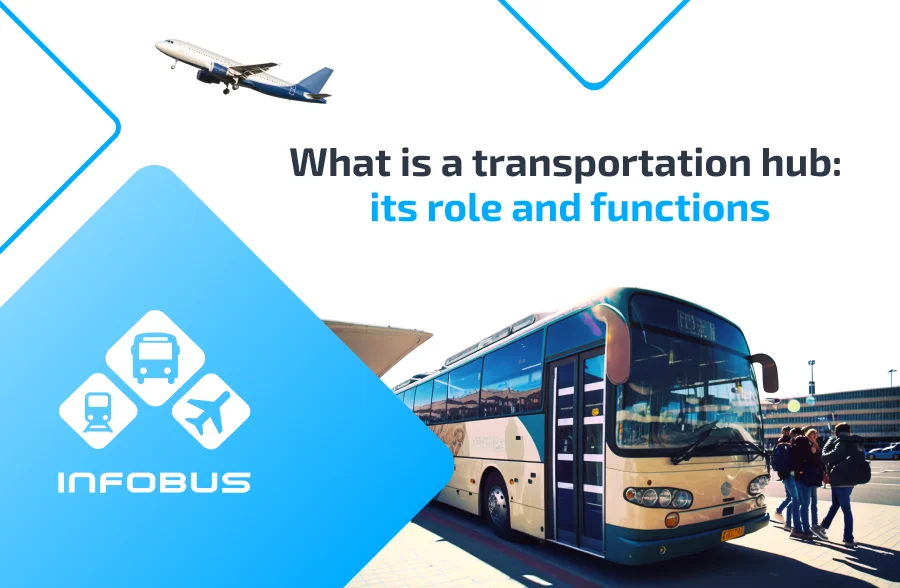
A transport hub is a place where different modes of transport intersect: air, rail and bus routes. It is here that you can easily change your travel direction or switch between modes of transport without any hassle. Put simply, it is a place where all logistics come together into a single system — so that passengers spend less time on transfers and more on the journey itself.
Why hubs are needed: key benefits
Transport hubs (interchanges) make getting around much easier, especially on long journeys. Here’s what this means in practice:
- Convenient connections.You can arrive at the airport and, without any unnecessary transfers, immediately board a train or bus to your destination. This saves time and stress, especially on complex routes.
- Stress-free navigation.In large hubs, everything is well thought out: electronic display boards, signs and information desks. It is easy to check timetables, find the right exit or find out about flight changes.
- Comfort whilst waiting.Modern terminals are no longer just a place to change flights. They offer Wi-Fi, cafés, shops and relaxation areas where you can comfortably spend a few hours between flights.
- Services nearby. Currency exchange, left-luggage facilities, car hire — all in one place. No need to waste time searching around the city.
- Security. Hubs are usually well-guarded and equipped with CCTV, so even a long layover is no cause for concern.
The combination of different modes of transport in one place makes such hubs key for international travel. And the INFOBUS service acts as an information hub, as it allows you to see all route options at a glance and book tickets for various modes of transport in one place.
The role of transport hubs
A transport hub is not just a place to change from one mode of transport to another. It plays a much broader role in the modern transport system, namely:
- Atransport hub serves as a junction point for various routes and modes of transport, forming a single transport network. This makes travel more convenient and accessible for people from different regions and countries.
- Improved efficiency. Hubs help to optimise routes and reduce journey times.
- Innovation. Hubs often become testing grounds for new technologies and innovations in the transport sector.
- Global significance. Major transport hubs play a vital role in the global economy, connecting countries and continents.
In today’s world, transport hubs are becoming not just transfer points, but centres of vitality, where opportunities and convenience come together for everyone seeking to travel, connect and grow.
The world’s most famous transport hubs
1. Aviation hubs
These are major airports through which millions of passengers pass every year.
- Changi (Singapore). One of the most comfortable airports in the world. It has everything: from a tropical garden to a cinema and even a huge waterfall. Transfers are organised so that you can move between transport options very quickly.
- Heathrow (London). One of Europe’s main transport hubs. It connects international flights with the Underground, rail and buses.
- Hartsfield-Jackson (Atlanta). The world’s busiest airport. It has its own train system running between terminals, which significantly speeds up transfers.
- Istanbul Airport. One of the newest and largest in the world. It connects Europe, Asia and Africa and is actively used as a transit hub.
2. Rail and multimodal hubs
Here, trains, metros, buses and other forms of transport come together:
- Zurich Central Station. An example of a perfectly organised system. Trains, trams and buses operate on a synchronised timetable, so transfers take minimal time.
- Shinjuku Station (Tokyo). The busiest in the world. Millions of passengers pass through here every day, and the station itself looks like a complex but well-organised system of passageways and platforms.
- Berlin Central Station. A multi-level station where trains run simultaneously on several levels. It is one of Europe’s key transport hubs.
Even if you don’t travel through such large-scale hubs, you encounter them all the time. For example, major bus stations in many countries operate on the same principle — bringing together different routes in one place so that you can quickly change transport.
If you have any questions, the INFOBUS round-the-clock support team will always be happy to help you sort everything out.
Subscribe to our social networks (Facebook, Instagram) and turn on notifications to be the first to receive notifications about new promotions!
Sincerely, INFOBUS!
Don’t miss out on promotions, discounts, and other exciting INFOBUS offers. Sign up for our newsletter and save on your trips!







Leave comment